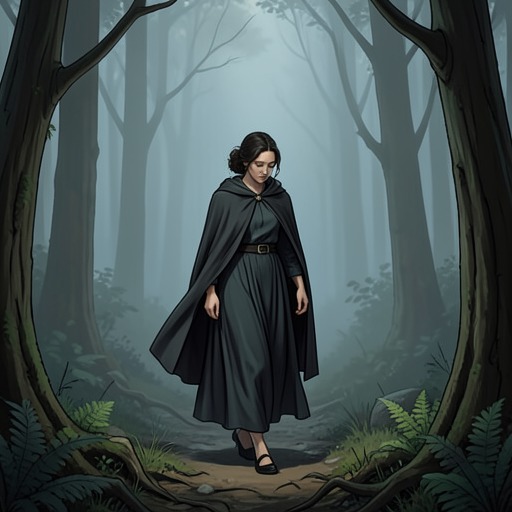
Dorothea's escape and flight into the mountains
Don QuixoteDorothea’s escape and flight into the mountains is the culmination of a chain of betrayals: Don Fernando abandons her after making promises of fidelity, and her attempt to confront him instead leads to public exposure, danger from her traveling servant, and a life of concealment in the Sierra Morena. In her retrospective account, escape offers no simple release. Each move meant to recover her standing or find safety exposes her to another threat, until the mountains become both refuge and a place of isolation.
The broken promise
Don Fernando first enters Dorothea’s chamber with the help of her maid, who has concealed him there. Before leaving, he assures Dorothea of his faith and the sincerity of his promises, and gives her a rich ring. Dorothea is left agitated and unsure how to understand what has happened. She does not immediately rebuke the maid, and tells Don Fernando that he may visit again until he chooses to make their situation known. He returns once the following night, then disappears from her view for more than a month, although she knows he remains in town. Dorothea watches for him in the street and at church, grows doubtful of his fidelity, and hides her sadness from her parents rather than invite questions she would have to answer with a false account.
The uncertainty ends when the town reports that Don Fernando has married Luscinda, a woman of distinguished family. Dorothea understands this news as proof that his promises to her have been abandoned. Her response is first an impulse to expose his treachery publicly, but she checks that impulse in favor of a plan: she will go to the city where the reported marriage took place and demand an explanation. The change from waiting to action is decisive. Rather than continue to rely on Don Fernando’s assurances, she sets out to discover what has happened and make him answer for it.
The journey and the public scandal
Dorothea confides her misfortune to a servant from her father’s household, a zagal, and asks him to accompany her. He objects to the boldness of her decision but agrees to go with her. She packs a woman’s dress, jewels, and money in a linen pillowcase, leaves home at night without informing the maid who had admitted Don Fernando, and travels on foot with her companion. They reach the city after two and a half days. There, a stranger directs her to Luscinda’s parents’ house and supplies an account of the betrothal.
According to this report, Luscinda fainted after accepting Don Fernando as her bridegroom. A paper in her own handwriting then disclosed that she considered herself already bound to Cardenio and had accepted Don Fernando only to obey her parents. The account also said a dagger had been found among her clothes and that Don Fernando, believing himself deceived, tried to attack her before those present intervened. Luscinda later told her parents of her prior bond with Cardenio; Cardenio, who had been present at the betrothal, left the city in despair. Luscinda herself could not be found. These reports give Dorothea grounds for hope: Don Fernando has not secured the marriage as she first feared, and she imagines that this obstacle may force him to recognize his earlier obligations. But she cannot find him, and hope does not restore her security.
Instead, Dorothea hears a public crier offering a reward for anyone who can find her. The notice gives details of her age and clothing and claims that the young man who accompanied her took her from her father’s house. The story wounds her reputation further by recasting her flight as an abduction by a socially inferior companion. She leaves the city with the servant that same night, now uncertain of his loyalty, and they enter the thickly wooded mountains to avoid discovery.
Danger and refuge in the mountains
In the solitude of the mountains, Dorothea’s servant turns from companion to threat. After she rejects his advances, he attempts to use force. Dorothea pushes him over a precipice; she does not know whether he survives. She then presses farther into the mountains, exhausted and frightened, with the immediate purpose of hiding from her father and those sent to search for her. Her departure from home had been an attempt to confront Don Fernando, but the journey has now become a search for safety from the consequences of her flight and from the man who accompanied her.
After an unspecified number of months, Dorothea finds work as a herdsman’s servant in a remote part of the Sierra Morena. She keeps to the open country and conceals her hair in order to maintain her disguise. When her employer discovers that she is a woman and shows the same kind of improper designs as the earlier servant, she sees no safe way to resist him there. Unlike the first encounter, she has no precipice or ravine at hand; she chooses to leave rather than test her strength or argument against him. Once again she hides among the crags, seeking a place where she can ask Heaven for help, strength to escape, or death in the wilderness. Her account thus distinguishes two kinds of flight: the first is a deliberate journey toward Don Fernando, while the later movements are forced retreats from danger.
Consequences and narrative significance
Dorothea’s account presents escape as an increasingly constrained choice. She leaves home with a specific aim and a companion she trusts; the public notice transforms that departure into scandal, and the companion himself becomes a danger. Her skill in adapting her clothing and labor gives her temporary shelter, but neither disguise nor work can guarantee her safety. The sequence ends not with reunion or vindication, but with her hidden among the mountain crags, still asking for help and fearing that her life may disappear without a trace.
The episode also brings several concealed relationships into view. Dorothea’s story establishes Don Fernando’s prior promises to her alongside his reported betrothal to Luscinda, while the account of the betrothal reveals Luscinda’s attachment to Cardenio. Cardenio is listening when Dorothea names Luscinda, and his visible distress connects her private history to the other broken bond in the story. The retrospective narration makes the mountains more than a setting for concealment: they are the place where the consequences of these intersecting promises become a present crisis, and where Dorothea must repeatedly choose between exposure and precarious refuge.